Organizations sit on a massive opportunity hidden inside their E&O parts, repair history, warranty curves, RMA failures, and BOM structures.
Most teams see the data, but almost no one can convert it into consistent, financially optimal actions at scale.
This is where the AIA (Artificial Intelligent Agent) Hungry Man creates value.
Hungry Man is not just a rules engine or a feature.
It is an Autonomous Intelligence Agent that lives inside the SKU Surfer process, continuously converting your operational data into trackable, visualized, and measurable financial outcomes.
Where SKU Surfer provides the landscape, Hungry Man creates the movement—driving each part, each SKU, each build path toward the most profitable outcome.
Powered by the Tallgrass Seq Architecture
Hungry Man reasons over the connected Tallgrass data foundation:
- Skuseq – Master SKU definitions, attributes, lifecycle
- PartSeq – Part identities, alternates, compatibility
- BomSeq – SKU-part relationships and exact requirements
- PriceSeq – Cost, resale ranges, market valuation
- EventSeq – Repair success, RMA patterns, warranty decay
These sequences give the AIA a 360°, financially anchored view of what you have, what it’s worth, what it can become, and what the best economic outcome is.
Hungry Man doesn’t operate abstractly — it operates on real numbers with real constraints that you define.
What Hungry Man Does Inside SKU Surfer
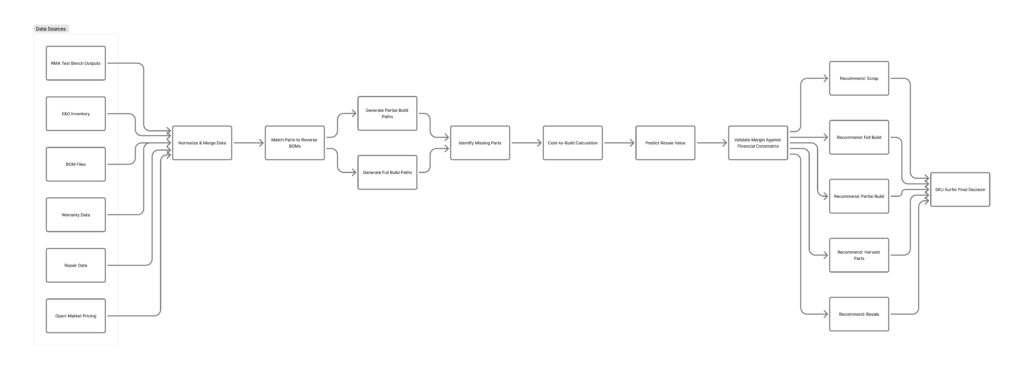
Hungry Man is the engine inside SKU Surfer that analyzes your E&O inventory and automatically generates profitable build paths or partial build paths—all based on the financial constraints you set.
It continuously evaluates:
- which E&O parts you have
- which SKUs can be fully or partially built
- what each build will cost
- what each build will return
- and what limits you’ve defined (labor, budget, part allocations, target margin, etc.)
Then it produces only the paths that meet your financial requirements.
1. Creates Full Build Paths When Inventory Allows
If your E&O inventory contains everything needed to complete a SKU economically:
✓ Hungry Man assembles a full build path
✓ Calculates total cost-to-build
✓ Projects resale value
✓ Verifies target margin
✓ Confirms it fits within the constraints you set
If it meets your financial criteria, it gets recommended.
If not, it is excluded.
2. Creates Partial Build Paths When Full Builds Aren’t Possible
When you don’t have enough parts for a full assembly, Hungry Man:
- calculates partial build viability
- identifies missing parts
- determines the cheapest way to fill gaps
- checks whether completing the build would be profitable
If completing the SKU is financially justified, it becomes a recommended partial build path.
If not, it stops the process before money is wasted.
3. Every Recommendation Depends on the E&O Parts You Actually Have
Hungry Man doesn’t work off theory or a static BOM.
It continuously evaluates:
- live E&O parts
- recovered parts from scrapped units
- parts produced during repair
- newly received RMA returns
- open-market prices for missing components
All build paths come from the inventory reality, not an ideal scenario.
4. Your Financial Constraints Drive Every Decision
You can set constraints like:
- minimum margin
- maximum part cost
- maximum missing parts allowed
- maximum labor hours per SKU
- preferred SKUs to prioritize
- SKUs to avoid
- target resale price
- maximum capital allocation per batch
- SKU-level profitability thresholds
Hungry Man never violates your rules.
It only recommends builds—full or partial—that satisfy your financial conditions.
5. Outputs the Most Economically Efficient Path for Every Part
Every part gets one of three outcomes:
- Use in a full build
- Use in a partial build that meets financial criteria
- Redirect to harvesting, resale, or liquidation if no path meets profitability targets
This ensures:
- no wasted labor
- no wasted parts
- no working on SKUs that don’t meet margin expectations
SkuSurfer’s simplistic data flow